

Glossary
Vacation rental glossary
Plain-English definitions of iCal, calendar sync, OTAs, PMS, direct booking, booking widgets, and other vacation rental terms: written for hosts.
iCal & sync
How availability data moves between platforms.
Calendar sync
Calendar sync is the process of keeping a rental's availability consistent across every platform it's listed on, usually by importing each platform's iCal feed into one place and, where supported, exporting a combined feed back out. The goal is one accurate picture of which dates are open, without checking each site by hand.
Double booking
A double booking happens when the same dates get reserved on two different platforms at once, because availability updated on one channel hadn't yet reached the other. It's the core risk of listing on multiple platforms, and the main problem calendar sync exists to prevent.
iCal (iCalendar)
iCalendar (iCal) is an open, cross-platform file format for representing calendar events: meetings, appointments, and, for vacation rentals, booked or blocked date ranges. It uses the .ics file extension and is read by nearly every calendar and booking tool, which is why Airbnb, Vrbo, Booking.com, and property management systems all publish and accept it.
iCal feed (iCal URL)
An iCal feed (or iCal URL) is a link to a live .ics file that a platform keeps updated automatically. Instead of exporting and re-importing a file by hand, a calendar tool subscribes to the URL and re-checks it periodically, so booked and blocked dates stay current without manual work from the host.
Webcal
Webcal is a URL scheme (webcal://) that tells a calendar application to subscribe to a live iCal feed rather than just download it once. Clicking a webcal link typically opens the default calendar app and adds the feed as an auto-updating subscription: the mechanism behind most one-click "add to calendar" shortcuts.
Platforms & software
The tools and marketplaces vacation rentals run on.
Channel manager
A channel manager is software that pushes rate and availability updates out to multiple OTAs at once from a single dashboard, so a host doesn't have to update Airbnb, Vrbo, and Booking.com separately. It typically connects through each platform's official API rather than iCal alone, which is what lets it push changes instead of only reading them.
OTA (online travel agency)
An online travel agency (OTA) is a website that lists rental properties or hotel rooms from many different hosts and takes a booking commission on each reservation made through the site. Airbnb, Vrbo, and Booking.com are the three OTAs most vacation rental hosts already use alongside their own website.
PMS (property management system)
A property management system (PMS) is all-in-one software for running a rental business: reservations, guest communication, channel management, payments, housekeeping, and reporting in one platform. It's built for hosts and property managers who want a single system to operate day to day, usually at a higher monthly cost than a single-purpose tool.
Booking & website
Turning calendar availability into a request or reservation.
Availability calendar
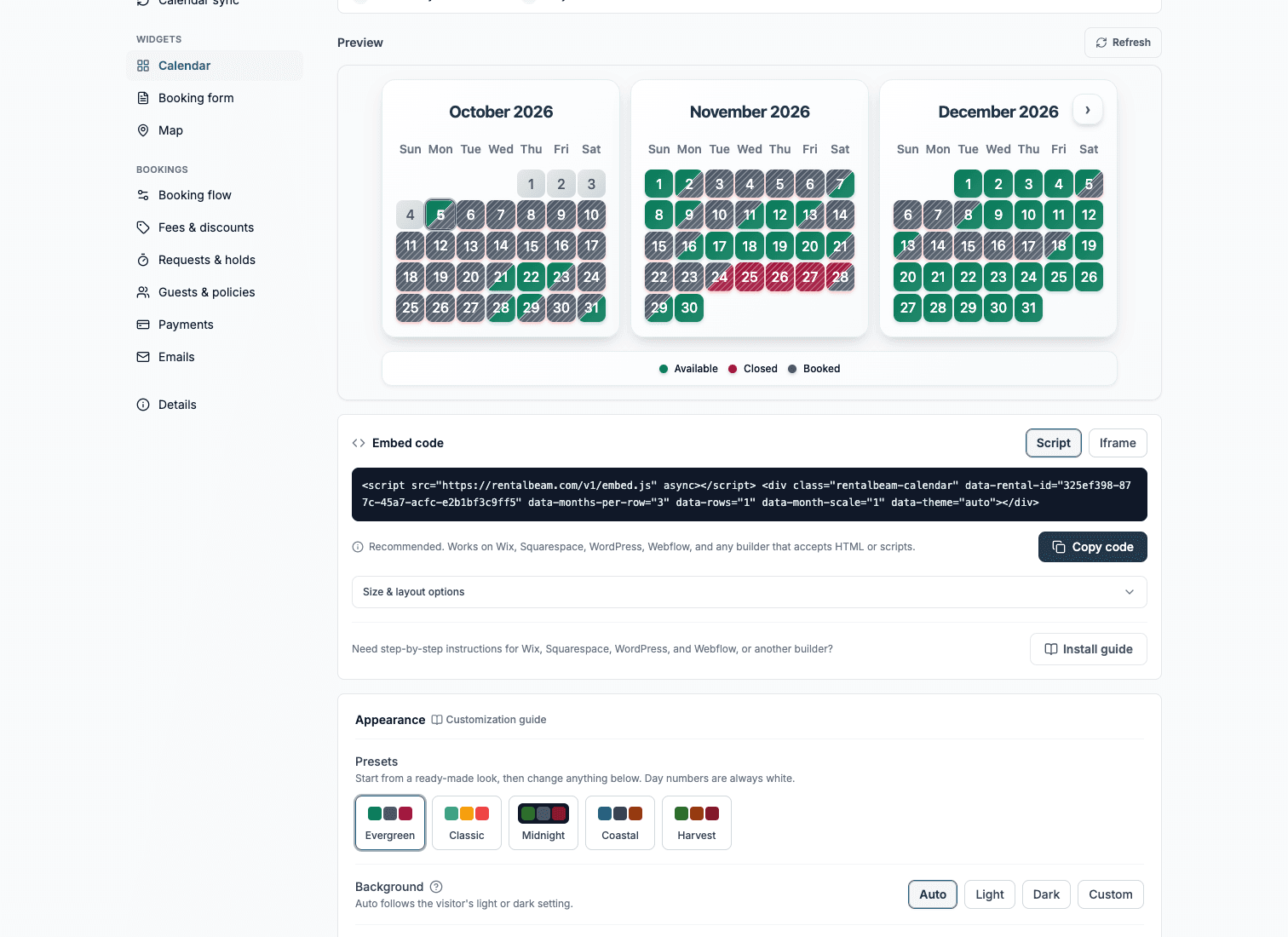
An availability calendar is a visual, month-by-month display of which dates a rental is open or booked, usually embedded directly on the host's own website. It's typically synced from one or more iCal feeds so it also shows bookings made on other platforms, such as Airbnb or Vrbo.
Booking widget
A booking widget (or booking form widget) is an embeddable form that lets a website visitor request or reserve a stay directly, without leaving the host's site. It typically checks live availability, calculates a price, and sends the request to the host: the direct-booking counterpart to an availability calendar, which only displays open dates.
Collection
A collection is a named group of a host's rentals shown together in one widget: one availability calendar with a combined, timeline, or tabbed view, one booking form where a guest picks dates and then a rental, or one map with a pin for each. Each rental keeps its own feeds, prices, and settings; the collection only decides what is shown together.
Direct booking
A direct booking is a reservation a guest makes straight through the host's own website, rather than through an OTA like Airbnb or Booking.com. Because no listing marketplace sits in the middle, the host avoids that platform's commission on the reservation and owns the guest relationship end to end.
Embed code
Embed code is the small snippet a host pastes into their own website to display a widget (here, an availability calendar or booking form), hosted and updated by the provider rather than built from scratch. It's typically a short JavaScript snippet or an iframe tag, both of which work on nearly any website builder.
Iframe
An iframe (inline frame) is an HTML element that embeds one web page inside another, rendering it in its own contained box with its own styles and scripts. It's the standard way to drop a widget built and hosted by one provider onto a website owned by someone else, without the two codebases interfering with each other.
Map widget
A map widget is an embeddable map that shows a rental's exact or approximate location on the host's own website, separate from the availability calendar and booking form. It typically supports a designed visual style, host-set privacy (exact pin or an approximate area), and pins for one rental or a set of rentals shown together.
Availability rules
The rules hosts use to control which dates are bookable.
Advance notice
Advance notice is the minimum number of days a guest must book ahead of their check-in date: a lead-time rule that stops a booking request from landing the same day, or the next day, with no time for the host to prepare. A zero-day setting allows same-day bookings; higher settings push the earliest bookable date further out.
Booking window
A booking window is the stretch of future time a host makes available to book: either a rolling number of days from today or a fixed cutoff date. Dates beyond the window aren't offered, which keeps a host from having to plan (or price) further ahead than they're comfortable committing to.
Changeover day
A changeover day (or turnover day) is the date one guest checks out and, often the same day, the next guest checks in. It's the tightest point in a rental's schedule, since cleaning, laundry, and any repairs have to happen in the gap between the two stays.
Minimum stay
A minimum stay is the shortest number of nights a guest is allowed to book in a single reservation. Hosts set it to avoid the extra cleaning and turnover cost of very short stays, and often raise it further during peak weeks when longer bookings are more valuable.
Prep time
Prep time is a buffer of one or more days a host blocks between bookings, so a new guest can't check in the same day (or within a set number of days) after the previous guest checks out. It gives cleaning, laundry, and any repairs guaranteed time on the calendar.
Pricing & revenue
How rentals price stays and measure performance.
Occupancy rate
Occupancy rate is the percentage of a rental's available nights that were actually booked over a given period: booked nights divided by total nights available, expressed as a percentage. It's one of the most common performance metrics in vacation rental and hotel management, used to judge how well a property is filling its calendar.
Seasonal pricing
Seasonal pricing is charging a different nightly rate for the same rental depending on the time of year: higher during peak demand (summer, holidays, festivals) and lower in the off-season. It's set as date-range overrides on top of a default rate, rather than one fixed price applied year-round.
Security deposit
A security deposit is a refundable amount a host asks a guest to cover in case of damage, excess cleaning, or a policy violation during the stay. In vacation rentals it's typically handled separately from the booking payment (as a card authorization hold or a separate request) and returned after check-out if nothing needs deducting.
See the product these terms describe.
RentalBeam is the availability calendar and direct booking widget behind many of these definitions: synced iCal availability, embed code for any website, and commission-free direct bookings.